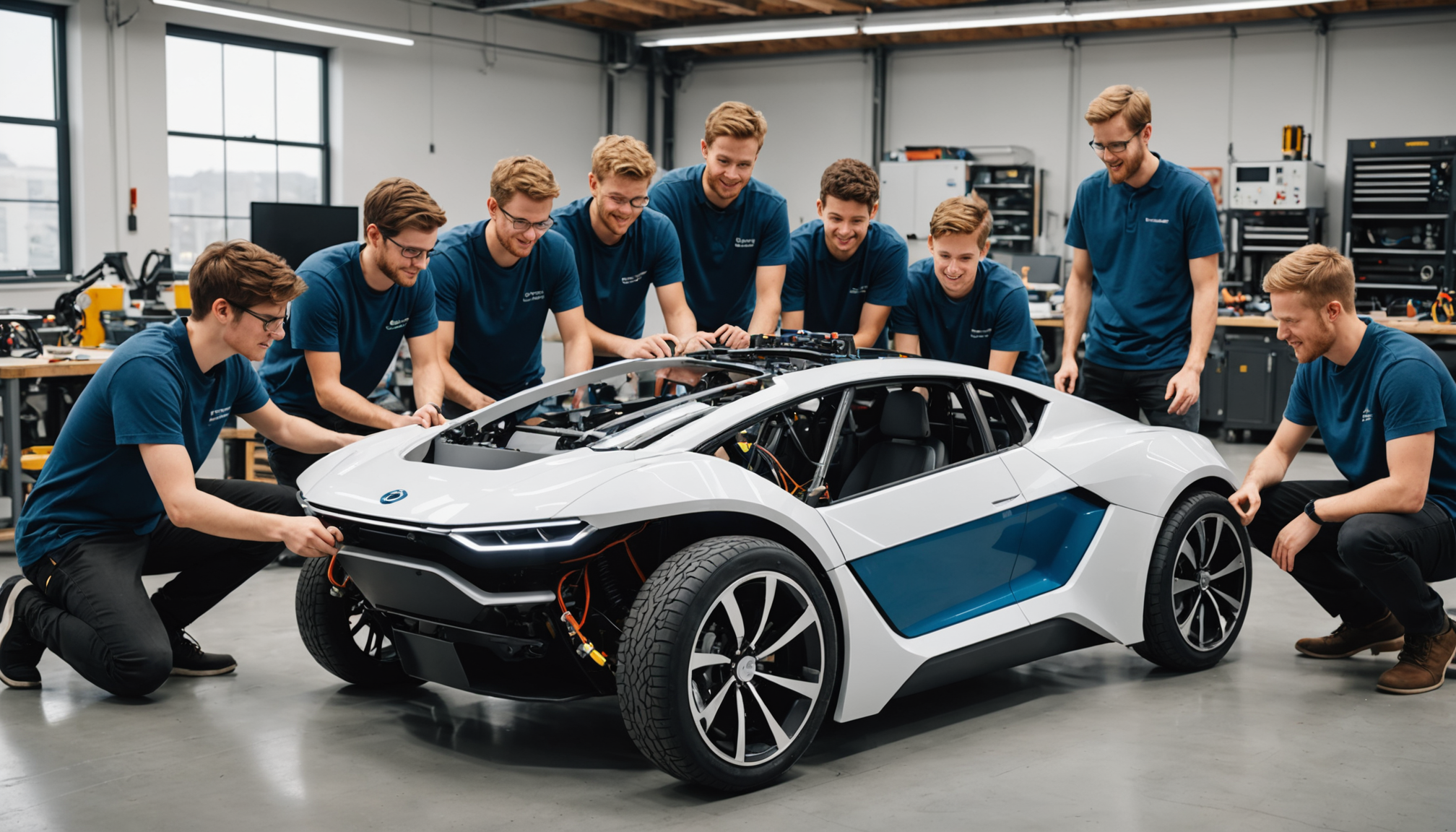
Discover how a bold group of students in the Netherlands are shaking up the auto industry with a groundbreaking electric car anyone can repair themselves. This project redefines green transportation and DIY culture.
In 2025, innovation meets sustainability as Eindhoven University students reveal ARIA, a modular electric vehicle designed to empower drivers with unprecedented repair freedom. The tech challenges status-quo manufacturing practices, calling for a revolution in how electric cars are made and maintained.
Redefining Auto Industry Standards through Modular DIY Electric Vehicles
The automotive world is no stranger to evolution, but in recent years, the pace slowed amid complex technology and expensive repair costs. Enter ARIA, an electric vehicle (EV) concept born from the inventive minds of Eindhoven University’s student team known as TU/ecomotive. This car is far from conventional.
At its core, ARIA embodies a modular design philosophy that enables owners to maintain and repair their electric car without costly visits to specialized mechanics. This DIY-friendly approach challenges traditional automobile manufacturers that rely on proprietary parts and service monopolies.
By offering a design where critical components — including six independent battery units, body panels, and electronic modules — can be swapped out using minimal mechanical know-how, ARIA tackles head-on the repair barriers many EV owners face today. Imagine being able to replace a failing battery module yourself instead of undergoing a full battery pack replacement that can run into thousands of dollars.
This new model not only lowers maintenance costs substantially but also extends the vehicle’s lifespan, creating a more sustainable cycle for electric city cars. For urban commuters conscious about their carbon footprint, ARIA represents a tangible leap toward greener, more accessible transportation.
The car’s specs match its revolutionary design. ARIA achieves speeds up to 56 mph (90 km/h) and offers a driving range of approximately 137 miles (220 km) — figures competitive for urban mobility. Powered by six interchangeable batteries with a total energy capacity of 12.96 kWh, the vehicle prioritizes energy efficiency and ease of servicing.
The dawn of modularity breaks the repair barrier for regular drivers
A Closer Look Into ARIA’s Innovative Technologies Driving Sustainability
The students behind ARIA have not only innovated on repairability but also pushed the envelope on integrating sustainable technology. Their vehicle is the tenth prototype developed by TU/ecomotive — an ongoing series known for inventive, eco-conscious designs. Past models have included cars that scrub carbon dioxide from the air and others built from recycled ocean plastics.
ARIA’s modular batteries stand out in particular. Rather than a single, massive battery pack, it employs six detachable cells, each easily exchangeable when their performance wanes. This strategy is a direct rebuttal to the industry norm of swapping entire battery packs, which remains expensive and resource-intensive.
The modular approach also benefits from an accompanying diagnostic app linked to the car’s dashboard, guiding owners step-by-step through repairs and maintenance. This smart tech simplifies troubleshooting, enabling less mechanically inclined users to handle issues independently. It represents a major shift in empowering users with control over their transport’s lifecycle.
By reducing repair complexity, ARIA also addresses the pressing under-supply of EV mechanics and the long wait times owners currently endure. In a nutshell, the students combined technology, software, and practical design to break down barriers preventing widespread sustainable transportation adoption.
- 🌍 Six detachable battery modules increase repairability and reduce waste.
- 🔧 Simple hand tools suffice for most maintenance tasks.
- 📱 Smartphone app offers diagnostics and repair tutorials.
- 💰 Repair costs drop significantly thanks to modularity.
- ♻️ Life expectancy of vehicle extended by easy part replacement.
When technology meets user empowerment and sustainability
Industry Disruptors and Right to Repair: How ARIA Advocates Consumer Control
The auto industry has been slow to embrace modular repair and DIY maintenance, largely due to complex engineering and commercial incentives that favor monopolized service models. ARIA stands as a daring pushback against this trend, aligning with the European Union’s burgeoning “Right to Repair” movement.
This movement champions legislation that forces manufacturers to design products optimized for long life and user repair instead of premature obsolescence. While current EU laws primarily address electronics and household appliances, electric vehicles have largely remained exempt.
Taco Olmer, the ecomotive team manager, points out that ARIA is a concrete example of what is achievable in passenger cars. “Right to Repair is about giving control back to the user,” he states. The team’s success serves as a rallying call to policymakers and legacy automakers to rethink product lifecycles and empower drivers instead of locking them into expensive, opaque service networks.
While ARIA remains a prototype without plans for commercialization, its impact reverberates beyond academic halls. It embodies a vision for a future where vehicle owners reclaim autonomy, maintaining their cars affordably and effectively without relying on dealerships or technicians.
Historic attempts at modular vehicles, such as the German startup ElectricBrands’ XBUS, have also shown promise but ran into funding hurdles. ARIA’s innovative design proves that modularity and sustainability can be mutually reinforcing without sacrificing functionality.
Consumers take back control in a traditionally closed industry
Practical Implications of DIY Modular EVs on Urban Life and Mobility
Beyond the tech and policy debates, ARIA’s real-world implications for daily urban life are compelling. For city dwellers accustomed to tight budgets and environmental concerns, the prospect of an affordable, maintainable EV is tantalizing.
Imagine commuting with an EV that can quickly have its battery swapped at home or body panels replaced without pricey shop visits. This flexibility reduces downtime and eliminates complex scheduling at dealerships. It also lowers barriers for those hesitant to adopt EV technology due to maintenance anxiety.
Armed with ARIA’s diagnostic app, even users with limited mechanical skills gain confidence to diagnose and perform minor repairs. This marks a significant democratization of vehicle maintenance — an arena traditionally shrouded in technical complexity and high costs.
Financially, ARIA’s modular philosophy could save consumers thousands over a vehicle’s lifetime. Vehicle owners become less exposed to escalating service charges and avoid being forced into premature vehicle replacement. That dynamic also encourages sustainability by curbing waste and fostering longer-lasting vehicle ecosystems.
| 🗓️ Activity | 📅 Scheduled Date | ⏰ Duration | 📍 Location |
|---|---|---|---|
| ARIA Prototype Launch | November 25, 2025 | Full day | Next Nature Museum, Eindhoven |
| EU Right to Repair Advocacy Meeting | December 10, 2025 | 3 Hours | Brussels, Belgium |
| Public Demo & Test Drive | January 15, 2026 | 6 Hours | Eindhoven City Center |
| Technology Workshop for Mechanics | February 5, 2026 | 8 Hours | Technical University Eindhoven |
Revolutionizing daily rides through accessible green transport
How Student-Led Innovation is Shaping the Future of Green Transportation
Student teams like TU/ecomotive at Eindhoven University serve as powerful engines for automotive innovation. Their work with ARIA doesn’t just push boundaries technologically but weaves sustainability and social impact into the core of vehicle design.
These young engineers are redefining what it means to contribute to green transportation: not just building a cleaner car but empowering users to sustain it affordably and autonomously for the long haul. Through the lens of ARIA, future mobility becomes less about corporate control and more about community collaboration and environmental respect.
This ripple effect encourages a shift away from disposable consumer habits toward durability and repairability. Other university teams and startups worldwide are inspired by such projects, spawning new ideas that prioritize modularity and user-friendliness over flashy but impractical tech.
- 🚗 Student-led projects pioneer sustainable automotive designs.
- 📚 Academic innovation fuels real-world environmental solutions.
- 🌱 Sustainability and DIY culture merge in practical applications.
- 💡 Encourages industry-wide focus on repair-friendly engineering.
- 🤝 Builds bridges between consumers, makers, and policymakers.
Education and activism converge to reshape industry norms

My Name Is Said I am a dedicated blogger sharing the latest trending blogs from the USA, covering news, updates, and informative stories. My focus is on delivering accurate, engaging, and timely content for readers worldwide.