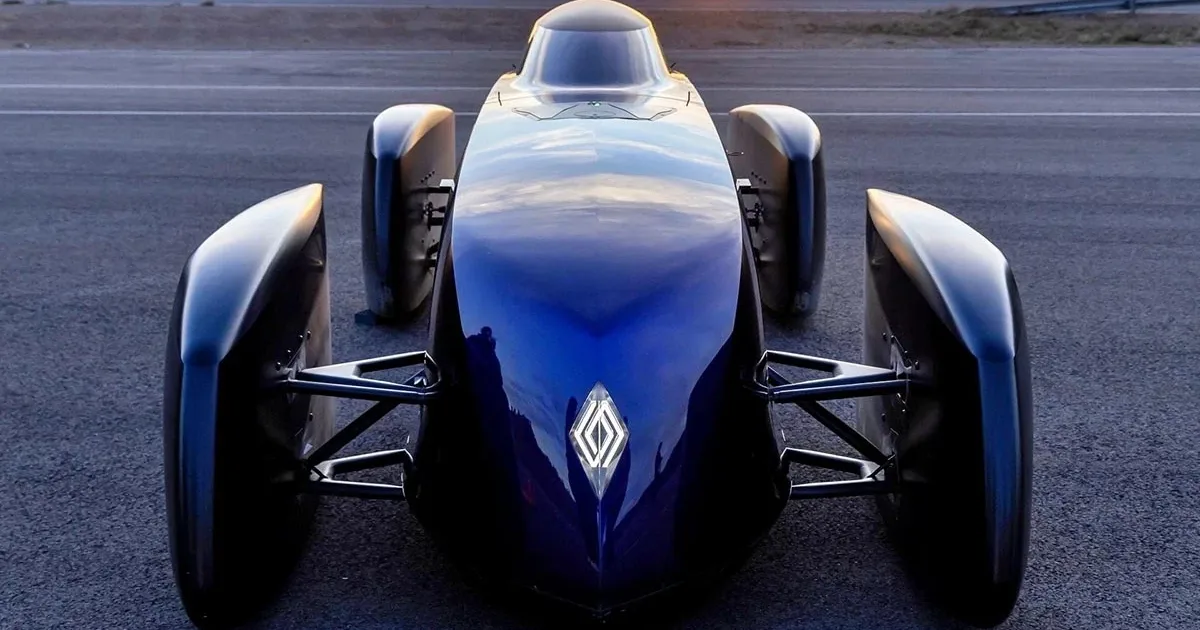
Renault’s Filante Record wasn’t a showroom tease it was a ruthless efficiency weapon that proved range anxiety could be beaten with physics, software, and obsessive weight-cutting, not bigger batteries.
Before sunrise in Morocco, a needle-shaped Renault prototype ran for nearly 10 hours straight and posted a number that sounded like a typo: 626 miles (1,008 km) without recharging. It did it with an 87 kWh battery pulled from an everyday Renault Scenic E-Tech, not some mythical lab pack. Average speed stayed highway-real at about 63 mph (102 km/h), with pro drivers rotating like it was an endurance race. The message landed hard: the next leap for EVs wasn’t only chemistry it was drag, mass, and control. A Record Run That Happened in the Real World, Not a Marketing Vacuum. Renault didn’t “hint” at efficiency it set a result on December 18, 2025, saying the Filante Record covered 1,008 km(626 miles) at an average 102 km/h (63 mph) without charging. That matters because the speed wasn’t a crawl; it lived in the territory where EVs usually bleed energy into the air. The Filante’s shape looked theatrical, but the achievement forced a practical question: if the battery stayed “normal,” what did the engineers change around it? This wasn’t the usual EV fairy tale where range gets quoted at city speeds and perfect temperatures. The run was presented as a focused efficiency exercise squeezing every unnecessary watt out of the car’s environment: aerodynamics, mass, and energy management. The Filante didn’t need a bigger tank. It needed less to fight.
Why The “French Batmobile” Shape Wasn’t Styling It Was a Weapon
The Filante’s body read like a dare: long, tight, smooth, and unsettlingly clean. That wasn’t art-school drama; it was a drag-reduction crusade. Renault framed the concept as a demo-car built around aerodynamic design and ultra-optimized weight for maximum range. The wheels were treated like a problem to be hidden, not celebrated because open wheels are turbulence factories. At roughly 63 mph (102 km/h), air resistance becomes the bully in the room. You can’t “power through” it efficiently; you either shrink it or you pay. The Filante’s silhouette tried to do what mainstream cars can’t: make airflow boring. That’s not sexy in a brochure, but it’s deadly on a stopwatch. And here’s the uncomfortable takeaway for normal EVs: many of them were designed to look tough, tall, and fashionable. The Filante acted like those priorities were a luxury tax. In a world where people complained about range in winter or on the highway, Renault quietly demonstrated the oldest hack in engineering: stop wasting energy first.
The Battery Wasn’t Magic That Was the Point
Renault said the Filante Record ran an 87 kWh battery “equivalent to that of Renault Scenic E-Tech electric.” Translation: the headline didn’t come from unobtainium. If anything, Renault tried to make the battery feel almost ordinary so the spotlight stayed on everything else. That choice flipped the narrative. The industry often sold progress as bigger packs, faster charging, and more cells. Renault’s demo implied a harsher truth: you can add 10 kWh and still get hammered by drag, rolling resistance, and extra mass. The Filante’s claim to fame was the ecosystem around the battery, the stuff that usually gets ignored because it doesn’t photograph well. Even the way Renault talked about it was revealing: “maximum optimisation of the battery’s environment.” Not “breakthrough chemistry.” Not “new platform.” Just relentless systems thinking and the willingness to build something extreme to prove it.
Weight, Controls, And The “Invisible” Tech That Made It Possible
Renault positioned the Filante as a weight-obsessed machine, saying it used aggressive weight reduction and modern materials to chase efficiency. In plain terms: every kilogram (and every pound) mattered because mass punishes you twice once when you accelerate, and again through rolling resistance. The cockpit was more interesting than it looked, too. Renault said it replaced traditional mechanical links with electronic systems: Steer-by-Wire for steering and Brake-by-Wire for braking, explicitly to save space and weight. That’s the kind of engineering you usually see when packaging is life-or-death racing, aerospace, prototypes that exist to make one number smaller. None of this suggested your next family crossover would look like the Filante. But the underlying moves lighter components, smarter packaging, fewer “legacy” parts were exactly how efficiency quietly improves without waiting for the next battery revolution.
The Numbers That Shocked People: Speed, Distance, And Energy Use
Renault stated the big metrics 1,008 km (626 miles), 102 km/h (63 mph), no recharge. Other reporting around the run also highlighted the efficiency figure of about 7.8 kWh/100 km, which converts to roughly 12.6 kWh/100 miles (and about 8.0 miles per kWh). Those are absurdly low numbers by mainstream EV standards at highway-like pace.
To keep the timing concrete, here’s the run profile as it was described publicly:
| Milestone | Local Date | What Happened | Duration / Pace |
| Record day | Dec 18, 2025 | Closed-course endurance run | ~10 hours total |
| Distance posted | Dec 18, 2025 | 1,008 km (626 miles) | Avg 102 km/h (63 mph) |
| Battery baseline | 2025 concept spec | Scenic E-Tech–equivalent pack | 87 kWh |
If you’re an EV buyer, the practical translation was brutal: range wasn’t only a battery problem. It was a design discipline problem. Renault didn’t “solve” it for production cars overnight but it showed where the low-hanging fruit had been hiding.
What This Would Have Changed for Everyday EVs If Automakers Took It Seriously
Nobody expected a single-seat, dart-shaped demo-car to become a best-seller. The value was strategic: Renault used a record to make efficiency feel aspirational again, after years of power and screen-size arms races. It reminded the market that EV progress wasn’t linear sometimes you jump forward by deleting things, not adding them. The Filante’s lesson wasn’t “drive like a monk.” It ran at real speed and still delivered outrageous numbers. That suggested future gains could come from boring improvements that compound: better underbody aero, smarter wheel design, lower rolling resistance, cleaner thermal management, and software that avoids wasting energy in the first place. It also exposed a cultural problem. Many EVs were sold as lifestyle objects first tall, wide, aggressive. The Filante treated those choices as optional. In a Europe where energy prices and charging infrastructure anxiety had real political weight, a quieter, more efficient EV future suddenly looked less like sacrifice and more like competence.
The Hidden Catch: Why This “Easy Win” Was Still Hard for Production Cars
The Filante was a proof-of-work, not a customer promise. Production cars have to carry families, crash structures, sound insulation, visibility, luggage, comfort, and style. That reality adds weight, worsens aero, and drags efficiency back toward earth. But that wasn’t an excuse it was the whole point. Renault built a boundary object: something extreme enough to show what physics allowed, then let engineers pull pieces back into normal cars. Renault even framed the demo as a culmination of human expertise and technology across a full team. That’s corporate-speak, sure but it also signaled this wasn’t a one-person passion project. It was a deliberate R&D flex. So yes, a family crossover wouldn’t hit 626 miles on 87 kWh at highway pace. But it didn’t need to. If the Filante nudged mainstream EVs even 10–15% closer to that efficiency, it would have been the difference between “charging plan required” and “stop thinking about it.”
Q&A
Was the Renault Filante Record a production car?
No. Renault presented it as a demo-car/concept built to push energy efficiency and prove a point about range.
What battery did it use?
Renault said it used an 87 kWh battery equivalent to the Renault Scenic E-Tech electric pack.
How far did it go, and how fast?
Renault stated 1,008 km (626 miles) at an average 102 km/h (63 mph) without charging, on December 18, 2025.
How efficient was it in U.S. terms?
Reported efficiency around 7.8 kWh/100 km translates to about 12.6 kWh/100 miles and roughly 8.0 miles/kWh.
Why did steer-by-wire and brake-by-wire matter here?
Renault said those systems replaced traditional mechanical links to save space and weight, supporting the efficiency mission.
Could this kind of range happen in a normal SUV soon?
Not at the same level. But the Filante suggested the next gains would come from aero, mass, and smarter control tech that can migrate into everyday cars.
Why did Renault run it as a record attempt instead of just publishing simulations?
Because a public, repeatable record is harder to dismiss. It forced the conversation back to measurable efficiency, not marketing promises.

My Name Is Said I am a dedicated blogger sharing the latest trending blogs from the USA, covering news, updates, and informative stories. My focus is on delivering accurate, engaging, and timely content for readers worldwide.