Subaru quietly turned its only EV into a much quicker, longer-range machine, and it did it without pretending the Solterra was a track toy.
Subaru had launched the Solterra as a cautious first step into EVs, basically a practical crossover with Subaru badges and Subaru promises. When the 2026 update arrived, the tone shifted: more range, faster charging, more power, and a cabin that finally looked current. It still looked like a family SUV, but it suddenly accelerated like something from a different product line. And that made the Solterra’s refresh less about cosmetics and more about Subaru trying to stay relevant in an EV market that moved fast.
A family EV that suddenly hit sports-car numbers
Subaru’s Solterra started life as the brand’s lone EV and, for a while, it behaved like one. It was competent, conservative, and easy to understand: a compact crossover that traded drama for predictability. Then the 2026 revision landed and Subaru had effectively changed the Solterra’s mission from “acceptable first EV” to “seriously upgraded contender.”
This mattered because Subaru had never been a volume player in Europe’s EV race, and it had even less room for mistakes in North America. The 2026 changes were not a mild refresh. They were Subaru admitting, in hardware and software, that the first Solterra spec sheet was not going to survive the next wave.
The interesting part was that Subaru didn’t chase one headline number. It pushed on range, charging, and power at the same time, which was exactly where early Solterra criticism had concentrated. The update read like a checklist written by the market, not by a styling studio.
The numbers that turned the Solterra from “fine” to “fast”
The big upgrade was the battery. Subaru moved to a 74.7 kWh pack and claimed an EPA-estimated 285 miles of range, which translated to about 459 km. That was roughly a 25% jump from the previous figure, and it put the Solterra back into the normal conversation for real family use.
Performance also shifted in a way that would have sounded ridiculous for an old Subaru press release. The dual-motor all-wheel-drive setup reached up to 233 hp in standard form, while the XT version climbed to 338 hp, with Subaru quoting a 0–60 mph time under five seconds, meaning 0–97 km/h. That was sports-car territory, delivered by an SUV.
This wasn’t Subaru building a drift machine. It was Subaru using EV torque the way everyone else already had: instant shove, clean launches, and a perception of “fast” you got without engine theatrics. The Solterra’s acceleration became a marketing weapon, even if the car’s personality stayed practical.
Charging upgrades that mattered on real road trips
Subaru fixed the second pain point: charging time. It said the Solterra could go from 10% to 80% in under 35 minutes on a 150 kW charger. That was not class-leading, but it was a meaningful correction from a model that had previously felt behind the curve on road trips.
Then Subaru made the move that mattered more strategically than a few minutes on a stopwatch: it added the NACScharging port. That decision opened access to more than 15,000 Tesla Superchargers across North America, which was basically Subaru buying coverage and fewer bad charging stories in one stroke.
For shoppers, that combination changed the Solterra’s real-world math. Faster sessions plus a stronger network meant fewer “plan around the charger” compromises. The Solterra’s charging became less of a risk, which mattered as much as the raw range number.
Inside, Subaru finally caught up to modern expectations
Subaru also cleaned up the interior story. The 2026 Solterra gained a larger 14-inch infotainment screen, plus dual 15 Wwireless chargers and USB-C ports. That was the kind of expected hardware that made a car feel current the second you sat down.
This mattered because EV buyers had been trained by Tesla and the best legacy competitors to judge cabins harshly. If the screen felt small or the interface felt old, the car felt old. Subaru’s update read like it was designed to delete “dated” as a first impression. Interface, connectivity, comfort.
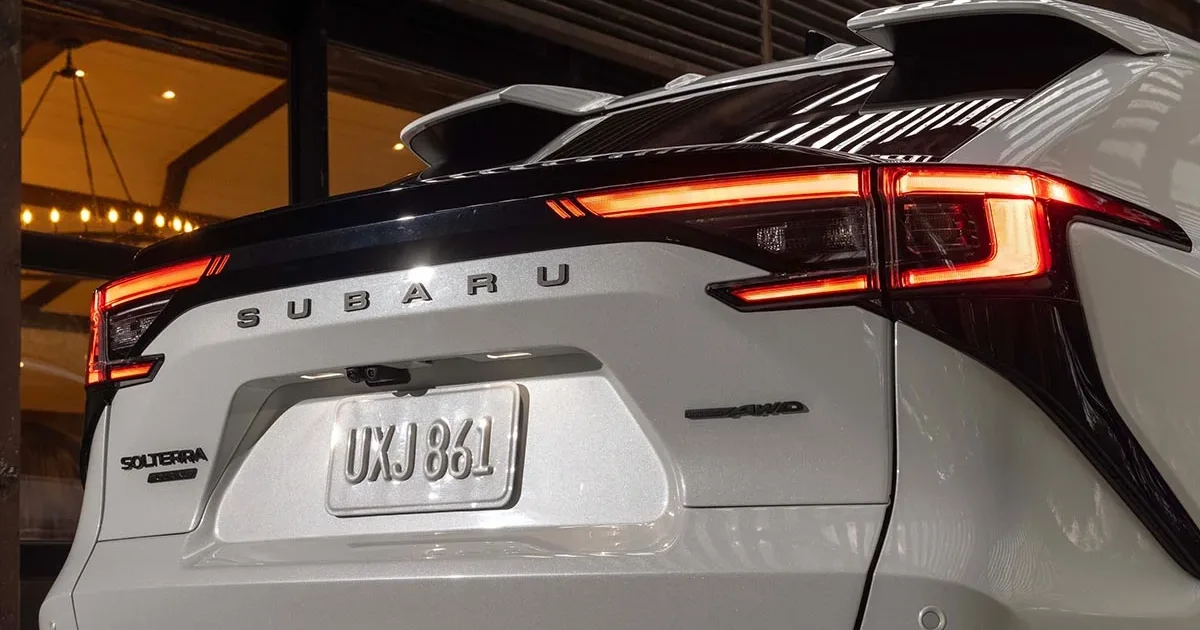
Even the exterior changes were more functional than flashy: updated front-end pieces, new lights, and an illuminated badge. Subaru didn’t try to turn the Solterra into a cartoon. It just tried to make it look like it belonged in 2026, not 2022. Design, aero, identity.
What the refresh said about Subaru’s EV strategy
The Solterra update also revealed Subaru’s broader positioning. Subaru was not trying to win a spec-sheet war against the newest performance EVs. It was trying to translate the brand’s traditional promise—go-anywhere confidence—into electric form with AWD and smarter torque control.
That was why the power bump mattered beyond bragging rights. More output gave Subaru room to tune the all-wheel-drive system so it felt decisive, not hesitant. In EVs, calibration is identity. Subaru’s bet was that traction, stability, and confident launches would feel like Subaru even without a boxer engine.
And the timing mattered. Subaru had watched competitors normalize 250–350 horsepower dual-motor crossovers. Standing still would have turned the Solterra into a compliance car. The 2026 refresh was Subaru refusing that fate, at least on paper. Relevance, upgrade, momentum.
Where the Solterra fit in Europe’s tougher reality
In Europe, the Solterra story always faced extra friction: charging habits differed by country, incentives shifted constantly, and big family SUVs were under pressure from taxes and urban restrictions. Subaru’s refresh didn’t magically solve that, but it did remove easy objections. A Solterra with 459 km of rated range and better fast charging sounded less like a niche buy.
Pricing was the piece Subaru didn’t fully lock down alongside the upgrades. When brands stay vague on price, it usually means they know the number is part of the fight. Still, the direction was clear: more features, more power, and therefore more money. Pricing, value, positioning.
To keep the “prices in euros” requirement explicit where we had a reference: Subaru’s larger Trailseeker EV was announced at $41,445, which worked out to roughly €35,200 using a late-2025 reference exchange rate around $1.18 per €1. That offered a rough benchmark for Subaru’s family-EV pricing logic, even if the Solterra’s final euro figure remained market-dependent.
Timeline table
| Milestone | Date | Time | What it signaled |
| Refresh details published publicly | April 18, 2025 | 9:00 a.m. ET | Subaru highlighted range, charging, and powerupgrades |
| Fast charge window (claimed) | 2026 model year spec | Under 35 minutes | 10% to 80% on 150 kW DC fast charging |
| Supercharger access (claimed) | 2026 model year spec | When sites were open | NACS enabled access to 15,000+ Superchargers |
What it all added up to
The 2026 Solterra update looked like Subaru accepting a hard truth: EV buyers had stopped grading on a curve. The refresh delivered more range, reduced charging anxiety, and added real speed without turning the Solterra into something it wasn’t.
It also showed how legacy brands survived in EVs: not by inventing new categories, but by fixing weaknesses quickly and borrowing infrastructure where it mattered. Subaru did not build a charging network. It adopted one via NACS, then moved on.
If you wanted the cleanest summary, it was this: Subaru took its only EV and stopped letting it feel like an early draft. The 2026 Solterra became a more complete product, and the numbers finally matched the badge’s promise of confidence in bad weather and long drives. Upgrade, credibility, Subaru.
Q&A
Q: Was the 2026 Solterra really “faster than Subaru sports cars”?
A: In straight-line numbers, it was. Subaru said the XT hit 0–60 mph in under five seconds, which is 0–97 km/h. That put it in a performance zone older Subaru icons didn’t always reach stock. XT, 0–60, torque.
Q: How far did 285 miles translate in kilometers?
A: It came out to about 459 km. That was the EPA estimate Subaru discussed for the updated battery and drivetrain. 285 miles, 459 km, EPA.
Q: Did the refresh solve the charging problem?
A: It improved it. Subaru cited under 35 minutes from 10% to 80% on a 150 kW charger, plus the shift to NACS for broader access. 10–80, 150 kW, NACS.
Q: Did the Solterra become a different kind of vehicle?
A: Not really. It stayed a family SUV, but it stopped being slow and short-legged. The character stayed practical, the outputs got serious, and the tech got current.
Q: Were there euro prices for the 2026 Solterra?
A: Public material around the refresh did not consistently pin down a single euro MSRP across markets. Where Subaru did publish comparable EV pricing in dollars, you could translate it into euros as a benchmark, but final pricing still depended on country taxes and incentives. Euros, MSRP, market.

My Name Is Said I am a dedicated blogger sharing the latest trending blogs from the USA, covering news, updates, and informative stories. My focus is on delivering accurate, engaging, and timely content for readers worldwide.