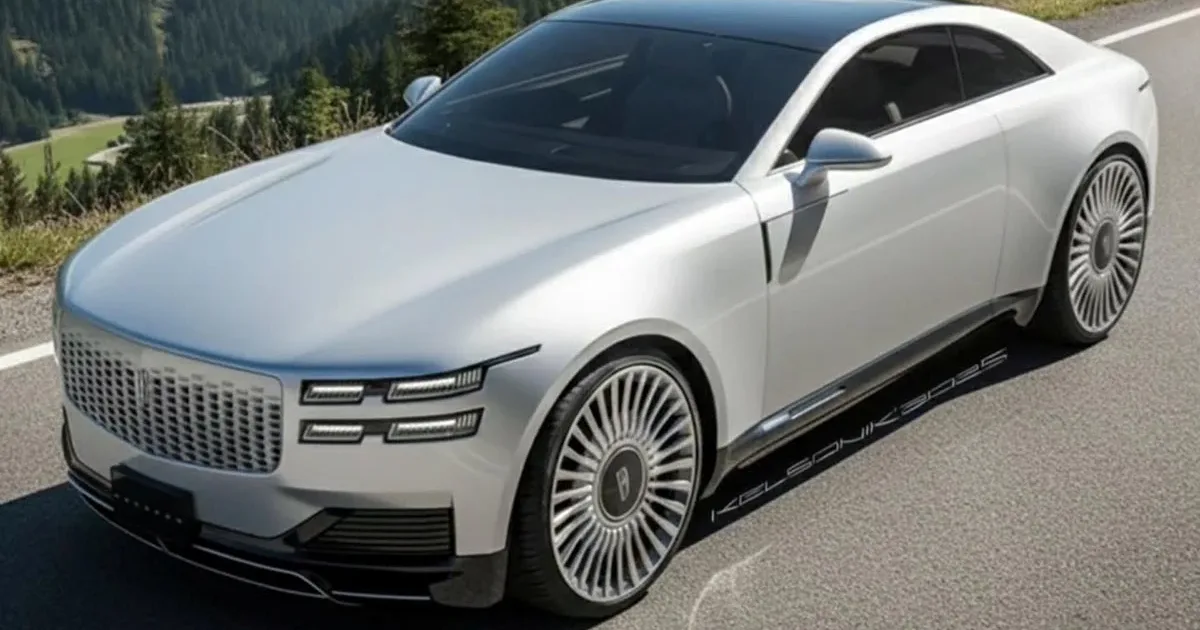
This radical Toyota concept quietly signaled that luxury did not have to surrender to full electrification to stay relevant, powerful, and culturally dominant.
For decades, the name Century meant almost nothing outside Japan. Yet in 2025, Toyota used the Century Coupé to send a carefully calculated message to the global luxury industry. While rivals rushed toward silent batteries and software-driven prestige, this concept leaned on presence, craftsmanship, and cultural authority to redefine what ultra-luxury could still be. Presented as a design study rather than a production promise, the Century Coupé was less about volume and more about influence. It was Toyota reminding the world that true luxury was not dictated by trends, but by restraint, confidence, and legacy. The result was a vehicle that looked nothing like European grand tourers and behaved nothing like modern EV flagships. Instead, it stood apart, almost defiantly, as a rolling manifesto of Japanese luxury philosophy.
A name that carried power long before global recognition
Since 1967, Toyota Century represented a form of institutional luxury that existed almost entirely within Japan. It was not marketed, not exported, and never designed to impress outsiders. Century sedans were built to serve emperors, prime ministers, and industrial leaders, prioritizing absolute discretion, ride comfort, and ceremonial presence over speed or visual drama.
That heritage mattered deeply when Toyota unveiled the Century Coupé concept. This was not a random styling exercise. It was the continuation of a symbolic lineage, one that had always rejected Western interpretations of prestige. While Rolls-Royce relied on spectacle and Bentley leaned into performance, Century relied on cultural authority and understatement.
By 2025, Toyota had already tested the boundaries of that identity with the Century SUV. The coupé concept went further. It suggested that Century was no longer just a model, but a brand-in-waiting, capable of standing above Lexus and speaking directly to the ultra-luxury elite on its own terms.
This move was not aggressive. It was deliberate. And that restraint was the point.
A silhouette designed to unsettle familiar luxury codes
At first glance, the Century Coupé appeared almost provocative. Its proportions defied classification. It was neither a traditional coupé nor a conventional SUV, but something deliberately ambiguous. The raised ride height, elongated hood, and fastback roofline gave it the stance of a monolithic object rather than a car shaped by wind tunnels.
The design rejected European elegance entirely. There were no flowing curves, no exaggerated creases, and no attempts to look athletic. Instead, the bodywork relied on clean surfaces, vertical authority, and a massive grille that communicated status rather than aggression.
One of the most striking elements was the absence of a B-pillar. Combined with rear sliding doors, the layout echoed traditional Japanese architecture, where openness and controlled transitions define luxury space. This was not theatrical. It was cultural symbolism translated into sheet metal.
The Century Coupé did not try to seduce. It asserted presence, and in doing so, it challenged the assumption that luxury must look fast, futuristic, or electric to feel relevant.
An interior built around silence rather than screens
Inside, Toyota described the Century Coupé as a One of One experience. This was not marketing exaggeration. The interior concept emphasized personalized craftsmanship, inspired by takumi artisanship rather than digital innovation.
Materials were selected for texture and acoustic properties, not visual excess. The cabin focused on sensory calm, where silence, softness, and spatial balance mattered more than interface complexity. Screens were present, but restrained. Controls were intuitive, not performative.
This approach directly contrasted with the prevailing luxury trend of oversized displays and animated dashboards. Where many flagship EVs leaned on technological spectacle, the Century Coupé leaned into experiential minimalism.
Toyota made it clear that this was a vehicle designed to be occupied, not driven. Chauffeur-focused ergonomics, rear-seat prioritization, and noise isolation were central to the concept. Luxury here was not about engagement. It was about detachment from chaos.
In a market increasingly obsessed with digital features, the Century Coupé suggested that the next frontier of luxury might actually be less technology, not more.
A quiet statement against full electric conformity
Toyota deliberately avoided detailing the Century Coupé’s powertrain. That omission was not accidental. By refusing to confirm whether the vehicle was electric, hybrid, or combustion-based, the brand made a strategic ambiguity part of the message.
At the time, most ultra-luxury manufacturers were publicly committing to full electrification. Silence was becoming synonymous with progress. The Century Coupé questioned that assumption without confrontation.
Given the Century SUV’s hybrid configuration, industry observers widely expected a plug-in hybrid or highly refined combustion system if the coupé ever reached production. Comfort, smoothness, and reliability mattered more than zero-emission symbolism.
This position aligned with Toyota’s broader philosophy. Rather than racing toward full electrification, the company emphasized technological pluralism, arguing that luxury clients valued dependability and experience as much as environmental signaling.
In that context, the Century Coupé acted as a counter-narrative. It suggested that prestige did not require abandoning proven engineering simply to follow global trends.
An attempted elevation beyond Lexus
One of the most significant implications of the Century Coupé was its brand positioning. Toyota made it increasingly clear that Century was being developed as an identity separate from Lexus, not an extension of it.
Where Lexus focused on global luxury markets with a blend of performance, technology, and refinement, Century targeted a narrower, more ritualized definition of status. This placed it closer to Rolls-Royce and Bentley in pricing ambition, but fundamentally different in philosophy.
The Century Coupé reinforced that distinction. Its design language, interior priorities, and conceptual messaging did not align with Lexus at all. Instead, they pointed toward a culturally rooted luxury marque, one that valued symbolism and authority over universal appeal.
This strategy carried risks. Outside Japan, Century lacked brand recognition. Convincing international buyers to accept a Japanese ultra-luxury marque above established European names would be difficult.
But Toyota appeared comfortable with that challenge. The goal was not volume. It was legitimacy at the very top.
Market uncertainty and controlled exclusivity
Toyota never announced production plans for the Century Coupé. That uncertainty only strengthened its impact. By remaining a concept, the vehicle avoided the compromises of regulation, pricing, and scale.
Industry speculation suggested that if produced, the Century Coupé would likely appear as a limited series, potentially restricted to Japan, the Middle East, and select U.S. markets. Pricing estimates ranged well beyond €250,000 (about $270,000), placing it firmly in ultra-luxury territory.
European availability remained unlikely. Emissions regulations, market preferences, and brand familiarity all posed barriers. Yet that limitation reinforced the concept’s exclusivity rather than diminishing it.
In many ways, the Century Coupé functioned exactly as intended. It was not meant to sell units. It was meant to reshape perception, both of Toyota’s luxury ambitions and of what prestige could mean in a post-electric narrative.
A symbolic pivot rather than a commercial one
The Century Coupé ultimately mattered less for what it was and more for what it represented. It marked a moment when Toyota publicly asserted that luxury leadership did not belong exclusively to Europe, nor did it require blind adherence to electrification.
By blending heritage luxury, radical design restraint, and strategic ambiguity, the Century Coupé challenged assumptions across the industry. It reminded competitors that confidence, not compliance, defined authority at the top.
Whether or not the vehicle ever reached production, its message was already delivered. Toyota had demonstrated that it could play in the highest luxury arena without copying its rivals or abandoning its values.
This concept did not shout. It stood still, and let the industry notice.
Q&A
Was the Toyota Century Coupé a production model?
No. It was presented as a concept vehicle, intended to showcase design philosophy and brand direction rather than confirm immediate production plans.
Did the Century Coupé use a V8 engine?
Toyota did not officially disclose the powertrain. Historically, Century models used large displacement engines, but by 2025, hybrid systems were more likely than pure V8 configurations.
Was the Century brand positioned above Lexus?
Yes. Toyota signaled that Century would operate above Lexus, targeting ultra-luxury clients with a more exclusive and culturally distinct offering.
Was the concept aimed at European buyers?
Not primarily. The Century Coupé was designed with Japanese luxury values in mind, with potential appeal in select global markets rather than broad European adoption.
Did the Century Coupé oppose electrification?
It did not reject electrification outright. Instead, it questioned the idea that full electric powertrains were mandatory for modern luxury authority.

My Name Is Said I am a dedicated blogger sharing the latest trending blogs from the USA, covering news, updates, and informative stories. My focus is on delivering accurate, engaging, and timely content for readers worldwide.