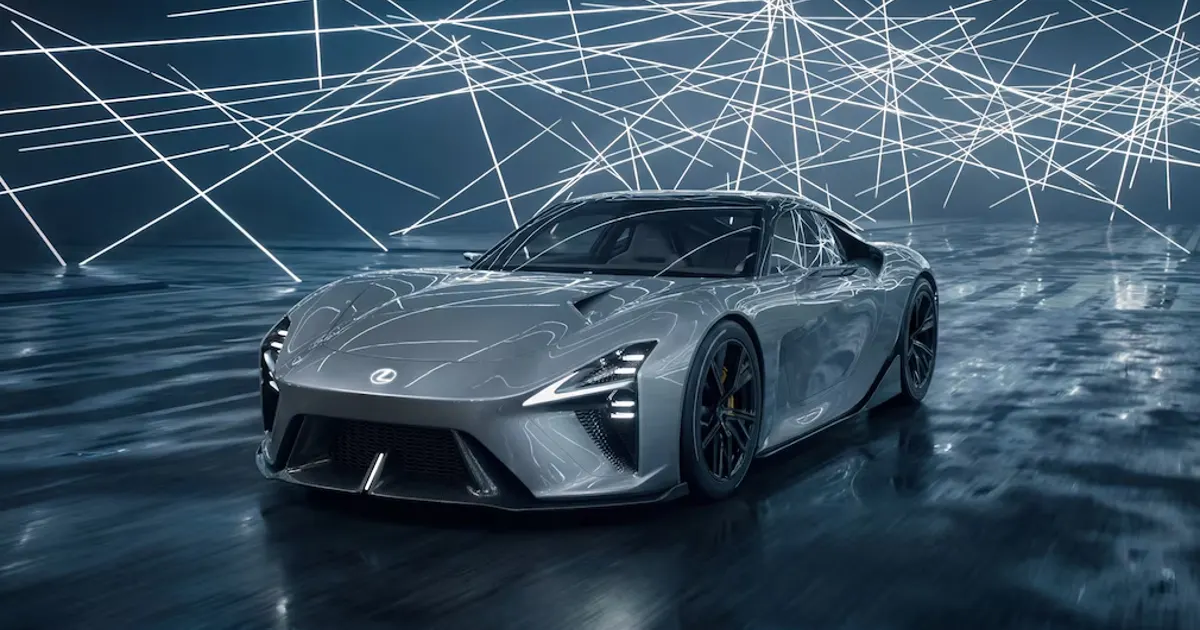
Lexus unveiled the LFA Concept as a battery electric supercar study that tried to carry the brand’s old performance myth into an EV future, without pretending the past still ran the show.
The reveal was framed as a new chapter, not a reunion tour. The badge was familiar, but the mission was electric and unapologetically modern.
The concept leaned on motorsport logic, low mass ideals, and a cockpit built for focus. It was the kind of show car that sounded like a warning: Lexus still wanted to build emotion.
| Date | Local time | Moment | What it signaled |
| Late Oct 2025 | time not reported | Visitors saw a sporty Lexus study at Japan Mobility 2025 (then called “Lexus Sport Concept”) | Lexus tested the waters with performance and visibility |
| Dec 5, 2025 | 3:00 a.m. CET (9:00 p.m. ET, Dec 4) | Lexus presented the full LFA Concept as a world premiere | The brand made the name and the direction official |
| 2027 or later | time not reported | Lexus indicated a series model was already being developed | The project looked real rather than pure theater |
The name that carried real weight
Lexus did not pick the “LFA” label by accident. That name already meant something to the kind of buyer who memorized engine notes and production counts. The original LFA had become a modern collectible, built in a strictly limited run of 500 units, developed over more than a decade, and remembered for a high revving V10 that delivered about 560 PS (roughly 552 hp) at an eye watering 9,000 rpm. In other words, the name was a loaded weapon, full of heritage, rarity, and expectation.
Bringing that badge back on an EV concept was risky because it invited direct comparison to a car famous for sound and mechanical drama. Lexus chose to lean into that tension instead of avoiding it. The concept framed “LFA” as an idea, not a cylinder count. It treated the name like a promise of uncompromising intent, even if the powertrain had changed completely. That was Lexus betting on identity, memory, and audacity.
The internal push that made it happen
The idea for the concept was described as coming straight from Toyota’s top level leadership, tied to a desire to translate a lightweight coupe into the next era. That detail mattered because it suggested this was not just a design studio flex. It sounded like a strategic project backed by someone who cared about what a “real” sports car should feel like. Lexus talked about learned know how, precision, craftsmanship, and the pursuit of a no excuses driving experience. Those words were old school, almost stubbornly so, and they were deployed to justify a very new battery and architecture.
At the same time, Toyota and Lexus were not treating performance as a single lane. The narrative placed the LFA Concept alongside development of the Toyota GR GT and GR GT3, each linked to a 4.0 liter twin turbo V8. That split approach said a lot. Toyota’s performance arm kept internal combustion alive for racing flavored projects, while Lexus used the LFA Concept to explore what a flagship could be in an EV world. It was a deliberate portfolio, a two track strategy.
The engineering targets that sounded like motorsport
Lexus framed the concept around three technical goals that read like a race team’s whiteboard. The first was a low center of gravity, the kind of requirement that makes an EV’s underfloor battery either a gift or a curse depending on packaging. The second was low weight paired with high rigidity, which is where the hardest engineering battles live because batteries add mass even when the structure is clever. The third was maximum aerodynamic efficiency, a polite way of saying the car needed to be stable at speed without looking like an appliance. The concept tried to solve these with stiffness, aero, and discipline.
The body was described as fully aluminum, paired with a purist, driver centered interior package. That combination suggested Lexus wanted the car to feel engineered rather than decorative. Aluminum can support precision and rigidity, but it also demands careful manufacturing and cost control. Choosing it for a supercar concept was a signal: the project was aimed at genuine performance, not just a show stand sculpture. Lexus was selling craft, precision, and control.
The proportions that made it look serious
The concept’s stance did most of the persuasion. Lexus used the freedom of electric packaging to stretch the proportions into something closer to a true supercar than a sporty grand tourer. The front sat low, the rear flowed outward, and the silhouette looked long and pulled tight. It echoed the original LFA’s shape, but it read cleaner and more timeless, like a modernized memory rather than a retro tribute. That is a hard line to walk, and the concept walked it with proportion, presence, and restraint.
The numbers reinforced the message. Lexus listed the concept at 4.69 m long, 2.04 m wide, and only 1.20 m tall. In US terms that worked out to about 15 ft 4.6 in (4.69 m) in length, 6 ft 8.3 in (2.04 m) in width, and 3 ft 11.2 in (1.20 m) in height. The wheelbase was 2.73 m, roughly 8 ft 11.5 in. Those dimensions placed it firmly in the high performance coupe conversation, with two seats, wide haunches, and a footprint that could stand next to modern exotics without looking out of place. It was built for stance, stability, and intent.
The rear light signature and the supercar body language
Design details were used like punctuation. The rear displayed a slim light band that flowed into sharply drawn tail lamps, emphasizing width and making the car look planted even when stationary. That kind of horizontal lighting is not just style, it is a perception tool. It makes a car feel lower and broader, which is exactly what a supercar needs when it cannot rely on a huge engine bay for drama. Lexus used lighting, width, and tension to create emotion.
The fenders were strongly flared, and the overall surfacing avoided busy clutter. That mattered because EV supercars can easily look generic if designers over correct with fake vents and exaggerated grilles. The LFA Concept looked like it trusted its own shape. It used sharp edges where they had purpose and smoother planes where they helped airflow. That balance suggested the design team was thinking like engineers, not just stylists, leaning on function, aerodynamics, and clarity.
The cabin that tried to fuse driver and machine
Inside, Lexus leaned into a familiar supercar obsession: making the driver feel physically connected to the vehicle. The concept used a motorsport style steering wheel and a bucket seat that appeared integrated with the front part of the cockpit, almost like the driver sat in a fitted shell. That kind of design is not just aesthetic. It signals a philosophy where the car is built around a single person’s inputs. Lexus was aiming for unity, feedback, and focus.
The rest of the cabin was described as radically reduced. Clear lines, minimal controls, and a digital instrument cluster suggested Lexus wanted to remove distraction and leave only essential information. The steering wheel itself was said to be narrow enough that the driver would not need to change hand position while turning in. That detail hinted at track thinking, the idea that ergonomics can improve performance by reducing small errors. Lexus presented the interior as a tool, built for ergonomics, precision, and simplicity.
The missing battery and power numbers that still spoke loudly
Lexus did not publish power output or battery specifications for the concept, and that silence was telling in two ways. First, it suggested the brand did not want the story to be reduced to a single headline number, not yet. Second, it implied the engineering was not locked down, or at least not ready to be pinned to a press release. But even without numbers, the project’s technical ambition and proportions made it hard to believe this was only a design statement. The concept looked like it was built to move, not just to pose. That was intent, ambiguity, and pressure.
The broader context mattered. With Toyota developing GR GT and GR GT3 projects around a 4.0 liter twin turbo V8, Lexus could afford to let the LFA Concept carry the “future” flag without abandoning combustion performance entirely within the corporate family. That gave Lexus cover to be bold. It could chase an electric supercar that prioritized experience, chassis response, and aero efficiency, while the racing adjacent projects carried other forms of speed. The LFA Concept became the spear point of an EV performance identity, built on experiment, confidence, and continuity.
What a production version would have needed to prove
Lexus indicated that a series model based on the concept was already being developed, with expectations pointing to 2027 or later. That timeline meant the production car would have faced an unforgiving market. By then, EV performance benchmarks would likely be higher, and buyers would be less impressed by concepts and more focused on real world range, repeatable track durability, and charging behavior. For Lexus to “bring tradition and future to the road,” it would have needed to deliver more than speed. It would have needed a convincing sense of character, the thing people remember after the numbers fade. That required thermal management, weight control, and feel.
There was also the emotional challenge. The original LFA was famous partly because it sounded like nothing else. An EV supercar cannot copy that. It has to invent a different kind of theater through steering, chassis balance, braking consistency, and the way power is delivered. Lexus’ messaging about unity and craftsmanship hinted it understood that. If the production version stayed close to the concept, it could have repositioned Lexus away from being “only luxury” and toward being “luxury plus drama,” a brand that made high performance feel carefully built rather than brutish. That would have been a meaningful shift driven by emotion, precision, and credibility.
Q&A
Q: Was the LFA Concept a gas powered successor to the original LFA?
No. Lexus presented it as a battery electric supercar concept, built around electric propulsion and a new era mindset.
Q: Why did Lexus reuse the LFA name at all?
Because the name carried instant performance credibility tied to the original limited 500 unit run and its high revving V10, and Lexus wanted that heritage to frame the new direction.
Q: What were the key engineering goals Lexus highlighted?
A low center of gravity, low weight with high rigidity, and maximum aerodynamic efficiency, which pointed to chassisfocus and aero discipline.
Q: How big was the concept in US measurements?
About 15 ft 4.6 in (4.69 m) long, 6 ft 8.3 in (2.04 m) wide, and 3 ft 11.2 in (1.20 m) tall, with a wheelbase around 8 ft 11.5 in (2.73 m). Those proportions screamed supercar and stance.
Q: Did Lexus reveal power or battery specs?
No. Lexus held back performance and battery data, but the technical framing suggested it was more than a pure design exercise, built with intent and ambition.
Q: What would a production version have needed to get right?
Weight, thermal durability, and driver feel. Without an engine soundtrack, the car would have needed to earn emotion through feedback and control.

My Name Is Said I am a dedicated blogger sharing the latest trending blogs from the USA, covering news, updates, and informative stories. My focus is on delivering accurate, engaging, and timely content for readers worldwide.