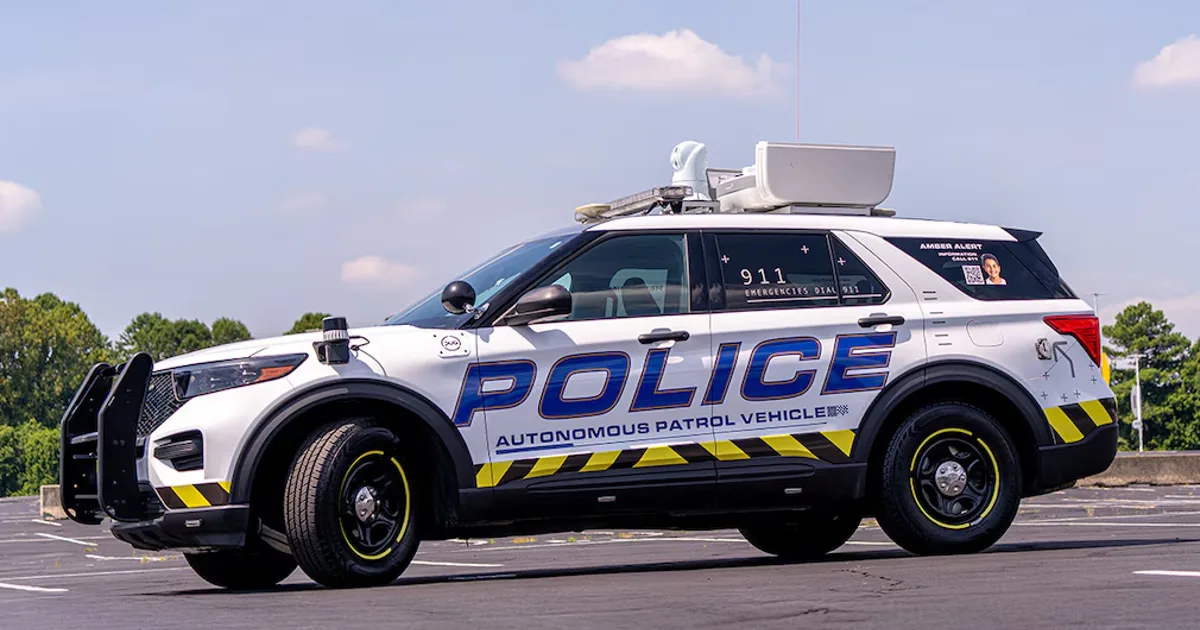
In October 2025, Miami-Dade launched a one-year pilot that sent an autonomous patrol vehicle into public service with no officer behind the wheel, betting that a high-tech “partner” could expand awareness without replacing human policing.
It rolled out quietly, but it carried a loud idea. A nonprofit called Policing Lab partnered with the Miami-Dade Sheriff’s Office to test a driverless patrol platform in real traffic. The vehicle, called a Police Unmanned Ground Vehicle, combined autonomy and AI with police-grade sensors and database access. The experiment promised better coverage and faster decisions, while forcing Miami to confront privacy and trust in the same breath.
| Date | Local time | Where | What happened |
| Oct 7, 2025 | 12:05 p.m. ET | Miami-Dade County, Florida | Pilot deployment began for the PUG autonomous patrol vehicle |
| Oct 7, 2025 | 6:05 p.m. CET | Reference time | Same moment, shown for EU readers |
| Oct 2025 to Oct 2026 | 12 months | Miami-Dade County, Florida | A full-year field test evaluated impact and acceptance |
A patrol vehicle with no officer in the seat
Miami’s first move was symbolic: it put a “police car” into public view without a driver. That one detail turned a normal tech pilot into a cultural event. A vehicle can be ignored, but a driverless patrol vehicle forces a question the second you see it: who is in charge right now. The pilot framed the PUG as a partner system, not a replacement for deputies, but the optics were unavoidable. A machine on patrol looks like policing, even when the human decision-making stays elsewhere.
The deployment sat inside a one-year pilot agreement involving the Miami-Dade Sheriff’s Office and Policing Lab, a nonprofit that positioned itself as an innovation bridge. That structure mattered. It suggested the program wanted room to learn, to adjust, and to measure, rather than committing to a purchase and then defending it. Still, the moment the PUG entered the street environment, the pilot became a real-world debate about public safety and automation.
What made this pilot different was not simply “autonomy.” Police departments had already used drones, cameras, and license plate readers. The shift here was mobility. Instead of sensors being fixed on poles or attached to a human officer, they were mounted on an autonomous platform that could move, linger, and observe. That expanded potential coverage, and expanded potential controversy, at the same time. It was coverage and scrutiny in one package.
What the PUG actually brought to the street
According to the pilot description, the PUG combined autonomous driving technology with artificial intelligence, plus real-time access to crime databases. That stack aimed to turn the vehicle into a rolling awareness node, not just a moving camera. It reportedly included 360-degree cameras, thermal imaging, license plate recognition, and even a drone launch capability. In plain language, it tried to see more, in more conditions, and report faster than a single human team could. That was the promise of sensors and speed.
The list of capabilities also revealed the program’s theory of value. Cameras and thermal imaging addressed observation, especially at night or in crowded environments. License plate recognition targeted routine detection tasks, like locating stolen vehicles or identifying plates tied to alerts. Database connectivity hinted at something more ambitious: linking what the vehicle saw to what the system “knew” in real time. If a patrol platform could reduce the time between observation and verification, it could potentially improve response coordination. That was the idea behind integration and automation.
But there was an immediate boundary question: what did the AI do, exactly. The program language suggested it supported situational awareness and routine tasks rather than making enforcement decisions. That distinction mattered because AI used for identification and ranking can quietly become decision-making if policy is not explicit. A system that flags plates, highlights anomalies, or prioritizes alerts effectively shapes human attention. Even without issuing citations, it can guide where deputies look and how they interpret a scene. That is where software becomes policy.
To make the capabilities easier to grasp, the stack can be summarized like this.
| Capability | What it did | Why it mattered |
| Autonomy | Drove and patrolled without an in-vehicle driver | Reduced the need for a dedicated operator in the car, increasing availability |
| 360-degree cameras | Recorded and monitored surroundings | Expanded visibility and created a consistent evidence stream |
| Thermal imaging | Detected heat signatures and activity patterns | Improved observation in low light, increasing awareness |
| License plate recognition | Scanned plates and matched against databases | Automated a routine task, boosting efficiency |
| Real-time database access | Pulled relevant records and alerts | Reduced the gap between observation and context |
| Drone launch system | Enabled aerial support from the platform | Potentially expanded coverage, raising oversight questions |
Even when the feature list sounded impressive, the pilot’s real challenge was simpler: prove it helped without making the community feel watched. Technology can be effective and still be rejected if people experience it as intrusive. In policing, perception is part of performance. That is trust as infrastructure.
Why the pilot emphasized community events and feedback
The pilot’s first-year assignment tied the PUG to community affairs, with deployments focused on public events. That was a strategic choice. Events are dense environments where visibility and deterrence are already goals, and where crowd management and safety monitoring can justify extra eyes. Using the PUG in that context let the sheriff’s office test the platform under controlled, high-traffic conditions without immediately placing it into more sensitive scenarios like traffic stops or neighborhood patrols. It was deployment with guardrails.
The program also included an on-board tablet that allowed residents to provide feedback directly. That detail signaled that the pilot understood how easily this could backfire. A driverless police vehicle can be read as “remote control authority” unless the department actively invites input. The tablet turned the PUG into a conversation starter, not only a sensor platform. That did not solve the privacy concerns, but it acknowledged the legitimacy of community reaction. It was engagement by design, not an afterthought.
Leadership messaging leaned on the same theme. The program was described as providing a high-tech partner that increased situational awareness and automated routine tasks, freeing deputies for complex and human aspects of policing. That framing tried to protect the core of policing as a human responsibility while positioning the machine as a tool that could reduce low-value workload. The stated goal was not to reduce headcount but to use resources more efficiently, ideally with no additional cost to taxpayers. That was efficiency and accountability being sold together.
Yet even this careful framing carried risk. Community trust does not come from features. It comes from rules. Residents tend to ask: what is recorded, who can access it, how long it is stored, and whether it will be used beyond the original purpose. A tablet for feedback can open the door, but policy has to walk through it. That is transparency meeting governance.
What the program claimed it wanted to measure
The pilot’s test objectives sounded straightforward: improve response times, deter crime, reduce officer workload, and strengthen public trust. Each goal was measurable on paper, but difficult to isolate in the real world. Response time depends on dispatch, staffing, geography, and call volume. Deterrence is notoriously hard to attribute to a single intervention. Workload reduction can be quantified, but only if the department tracks which tasks were actually shifted away from deputies. Trust is the hardest metric of all, because it requires community perception data, not just internal performance statistics. It was metrics versus reality.
A realistic test design would have needed baseline data. If the PUG was deployed at events, what were incident rates and response times at similar events before the pilot. If it scanned plates, how many hits were false positives. If it reduced routine work, what tasks were removed from deputies, and where did that time go. Did officers spend more time on community engagement, investigations, or paperwork. Without that accounting, “relief” becomes a story, not a finding. That is measurement and credibility.
There was also an implicit claim about safety: the idea that a machine could reduce risk exposure for officers by taking the first pass in uncertain environments. In practice, that only works if the platform can operate reliably, communicate effectively, and avoid creating new hazards. A driverless vehicle must be predictable to other road users, must fail safely, and must handle the messy edge cases of real streets. Public safety tech that causes accidents is not public safety. It is riskin a new shape.
Finally, the pilot sat in a broader narrative about staffing and resources. Police departments across the US faced recruiting challenges and rising service demands. A technology partner that expanded coverage without hiring more people was attractive. The danger was that agencies might treat technology as a substitute for community investment. The pilot’s messaging tried to avoid that by emphasizing that deputies remained central. But the underlying incentive was there. That is capacity and temptation.
Where autonomy ended and human policing began
The program repeatedly emphasized that the PUG did not replace police officers. That line mattered because it pointed to a governance principle: only humans should make enforcement decisions, at least in a system that wants legitimacy. A driverless vehicle can patrol and observe, but it should not decide who is suspicious, who deserves attention, or who should be stopped. Even if those decisions remain technically human, they can be influenced by what the system flags and how it displays information. That is authority and influence.
In practice, autonomy in a policing context has two separate meanings. The first is driving autonomy, the ability to move safely without a driver. The second is decision autonomy, the ability to take actions that affect people. The pilot described driving autonomy plus AI support, not decision autonomy. That is a critical line to keep sharp. The moment the system begins to initiate enforcement actions, the ethical and legal landscape changes drastically. Miami’s pilot sat on the safer side of that boundary, at least by its own description. It was navigation autonomy, not coercion autonomy.
Keeping humans central also meant defining accountability. If the PUG misidentified a plate, recorded a private moment, or caused a traffic incident, who was responsible. The vendor, the nonprofit, the sheriff’s office, or the operator supervising remotely. For the public, the answer is usually simple: the department is responsible. That makes policy design and oversight non-negotiable. The technology cannot be a shield. It becomes part of the agency’s behavior. That is responsibility and ownership.
The questions Miami could not avoid
Every capability in the PUG’s stack came with a corresponding demand for guardrails. 360-degree cameras raised retention and access questions. Thermal imaging raised questions about where and when it was used, and whether it captured bystanders. License plate recognition raised questions about data storage, sharing with other agencies, and error rates. Real-time database access raised questions about what data sources were connected and how alerts were verified. Drone launch capability raised questions about aerial monitoring and escalation. These were not theoretical issues. They were the difference between “tool” and “surveillance.” That is privacy and power.
There was also the issue of bias, even in a system that claimed to support rather than decide. If AI was used to prioritize alerts or highlight anomalies, it could shape patrol patterns and attention in ways that amplify existing disparities. Policing already carries uneven community experiences. Adding algorithmic triage can make those experiences feel more automated and less accountable, even if the intent is efficiency. To avoid that, the pilot would need transparency about what the AI did, how it was trained, and how false positives were handled. That is fairness and explainability.
Public trust was the pilot’s stated goal, but trust is earned through behavior. It requires clear rules, public reporting, complaint pathways, and independent oversight. A tablet for feedback is a start, but it cannot substitute for a published policy on retention, access, and use limitations. If residents believed the PUG was collecting data without meaningful constraints, they could interpret the project as a power grab rather than a safety initiative. In that case, the technology would increase tension. That is legitimacy and consent.
Finally, there was a practical question: what did the system do when it failed. Autonomous systems fail. Sensors get blocked. Networks drop. Software crashes. The pilot’s credibility depended on graceful failure modes. A driverless patrol vehicle that stops in traffic or behaves unpredictably could create new incidents, which would undermine the entire narrative of safety improvement. Reliability is not a bonus feature here. It is a prerequisite. That is resilience and safety.
What “success” would have meant after twelve months
At the end of the twelve-month pilot, success would not have been a single headline. It would have been a pattern of evidence: fewer routine tasks consuming deputy time, faster verification of certain alerts, improved visibility at events, and no major safety incidents caused by the vehicle itself. It would also have required a credible public reporting process, showing not only wins but errors and how they were handled. A pilot that only reports positives is not a pilot. It is marketing. That is evidence and honesty.
If the PUG meaningfully improved event operations, it could have become a template for other agencies. But scaling would have required more than buying vehicles. It would have required standard operating procedures, training for deputies on how to interpret and validate system outputs, and governance frameworks for data. Without those, agencies would adopt the hardware and improvise the policy, which is exactly how trust gets broken. Scale demands standardization and oversight.
The most realistic outcome for a first-year pilot would have been narrower than the hype: not a policing revolution, but a clearer understanding of where autonomy helps. Maybe it improved visibility at large gatherings. Maybe it reduced time spent on passive monitoring. Maybe it created a new feedback channel. Or maybe it revealed that community concerns outweighed operational benefits. Any of those findings would matter. The pilot’s value was in learning, not in pretending there were no trade-offs. That is learning and limits.
Q&A
Q: What was the PUG in the Miami-Dade pilot?
It was a driverless Police Unmanned Ground Vehicle deployed as a patrol partner, designed to support deputies rather than replace them.
Q: Who ran the pilot program?
The pilot involved Policing Lab, a nonprofit, and the Miami-Dade Sheriff’s Office, structured as a 12-month test.
Q: What tools did the vehicle reportedly carry?
It reportedly included 360-degree cameras, thermal imaging, license plate recognition, real-time database access, and a drone launch capability, a stack built for awareness and automation.
Q: Where was it used first?
In the first year it was tied to community affairs and used mainly at public events, a deployment strategy aimed at visibility and feedback.
Q: What was the pilot supposed to measure?
Whether it improved response time, deterred crime, reduced officer workload, and strengthened public trust, goals that required metrics and transparency.
Q: What was the biggest risk of the program?
That surveillance concerns, unclear data rules, or reliability failures could damage trust and create new safety issues, undermining legitimacy and safety.

My Name Is Said I am a dedicated blogger sharing the latest trending blogs from the USA, covering news, updates, and informative stories. My focus is on delivering accurate, engaging, and timely content for readers worldwide.