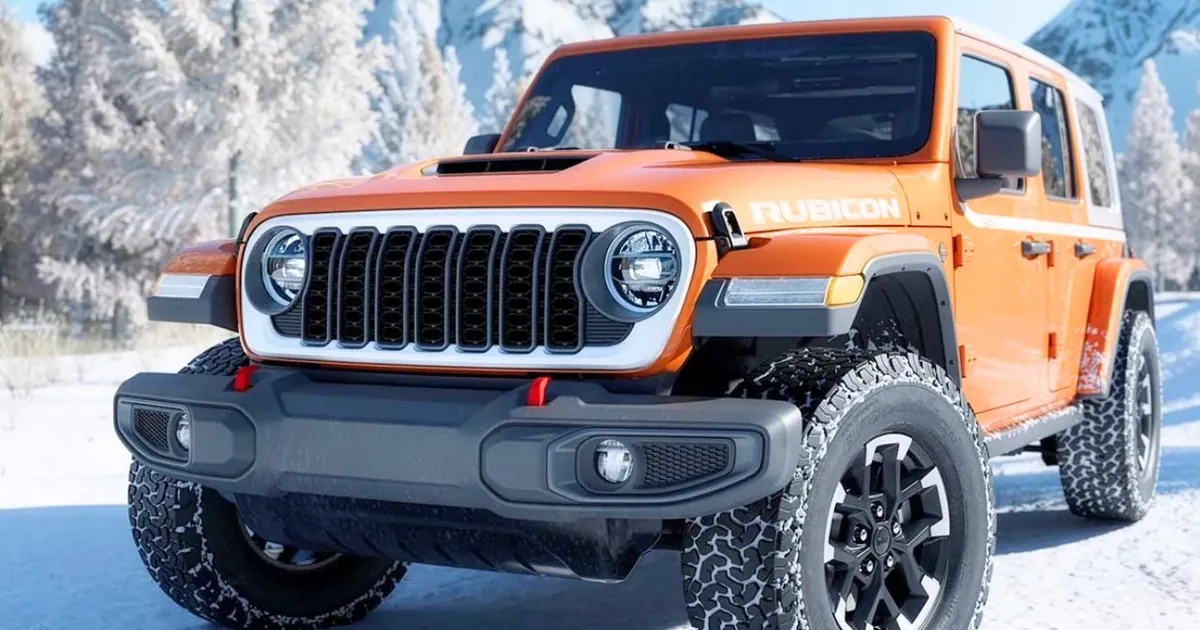
While the industry rushed toward batteries and software, Jeep quietly reminded the world that raw mechanical grit still mattered when the pavement ended.
At a time when electrification dominated headlines, the Wrangler Whitecap moved in the opposite direction. No new powertrain, no efficiency tricks, no digital reinvention. Just steel, torque, nostalgia, and an unapologetic refusal to soften its character. And for a certain audience, that was exactly the point.
A retro design rooted in Jeep’s military DNA
The Wrangler Whitecap was never about innovation. It was about memory, identity, and continuity. Jeep introduced the Whitecap edition as a visual tribute to its earliest civilian off-roaders, drawing directly from the CJ models of the 1960s. The name itself referenced the bright white hardtop, a deliberate nod to the removable roofs that once defined Jeep’s utilitarian image.
The design leaned heavily on contrast. A gloss white roof sat atop darker body colors, immediately breaking with the all-black trend that had come to dominate modern SUVs. The front grille followed suit, finished in matching white, reinforcing the retro aesthetic without slipping into parody. Subtle “1941” markings on the fenders reminded buyers where the lineage began.
On Rubicon variants, Jeep added specific hood decals, tightening the link between heritage and capability. This was not a redesign or a modern reinterpretation. It was a controlled visual callback, aimed squarely at brand loyalists, off-road purists, and buyers who valued authenticity over novelty.
A mechanical formula left deliberately untouched
Under the hood, Jeep made a clear statement by changing nothing. The Wrangler Whitecap retained the same internal combustion engines found across the standard Wrangler lineup. Buyers could choose between the 2.0-liter turbocharged four-cylinder producing 270 horsepower, or the 3.6-liter Pentastar V6 delivering 285 horsepower, depending on trim and configuration.
This decision was intentional. Jeep did not attempt to hybridize, downsize, or electronically assist the drivetrain. Instead, it preserved a fully mechanical ecosystem built around reliability, torque delivery, and proven off-road architecture. The Whitecap remained a Wrangler first, special edition second.
Core components like the Selec-Trac four-wheel-drive system, low-range transfer case, locking differentials, and solid axles carried over unchanged. Approach and departure angles stayed among the best in the segment, and articulation remained a defining strength. In other words, the Whitecap performed exactly as buyers expected a Wrangler to perform, without filters or software intervention.
Off-road credibility that ignored market trends
By the time the Whitecap appeared, many competitors had softened their off-road offerings. Independent suspensions replaced solid axles. Drive modes replaced mechanical levers. Jeep went the other way, doubling down on mechanical simplicity, field repairability, and terrain dominance.
On trails, the Whitecap behaved no differently than its Rubicon siblings. It climbed rock faces, crossed deep ruts, and crawled through mud with a level of composure that few modern SUVs could match. This was not speed-based performance. It was slow-speed control, torque precision, and structural resilience.
Where electrified rivals struggled with weight and thermal management, the Whitecap thrived on predictability. There were no battery cooling concerns, no power derating under load, and no range calculations before venturing far from civilization. Fuel consumption was secondary to operational confidence, a trade-off its buyers willingly accepted.
Pricing strategy built on emotion rather than value
The Wrangler Whitecap was offered as an appearance package rather than a standalone trim. Pricing varied depending on the base model. On the Sahara, the package added roughly $2,690. On the Rubicon, the surcharge climbed to about $3,185. The Rubicon X version required only $495, as it already included several overlapping design elements.
Fully configured, the Whitecap pushed total pricing into the $51,000 to $58,400 range, depending on engine choice and optional equipment. Objectively, this placed it well above many competitors offering more technology and better efficiency.
But objectivity missed the point. Jeep was not selling specifications. It was selling identity, nostalgia, and belonging. For buyers who viewed the Wrangler as a cultural artifact rather than a transportation tool, the premium felt justified.
Interior familiarity reinforced the no-compromise message
Inside, the Whitecap mirrored the standard Wrangler cabin, blending modern infotainment with rugged materials. Digital instrumentation coexisted with physical buttons. Surfaces favored durability over elegance. The design made no attempt to feel futuristic.
Leather upholstery, a central touchscreen, and updated driver aids ensured baseline comfort, but the focus remained on function, visibility, and control. Water-resistant materials, removable doors, and exposed fasteners reminded occupants that this vehicle was designed to be used, not curated.
This interior philosophy aligned perfectly with the Whitecap’s exterior message. Nothing felt softened or sanitized. It was a cabin built for dust, mud, and long days off-road, not touchscreen demonstrations or autonomous driving experiments.
Market limitations outside North America
While the Whitecap resonated strongly in the United States, its prospects elsewhere remained limited. In Europe, regulatory pressure made its arrival unlikely. The Wrangler was already restricted to plug-in hybrid 4xe versions to comply with emissions standards, and the Whitecap’s purely combustion-based setup fell outside acceptable thresholds.
Adapting the design package to a hybrid platform would have required additional homologation, raising costs and complexity. Given shrinking demand for large off-roaders in Europe, Jeep showed little incentive to pursue that route.
As a result, the Whitecap remained largely a North American phenomenon, where off-road culture, open spaces, and fuel pricing still supported vehicles of its kind. In that environment, limited editions like the Whitecap continued to generate attention and showroom traffic.
A heritage strategy aimed at preserving relevance
The Whitecap formed part of Jeep’s broader heritage-focused initiative, which rolled out multiple limited editions over a twelve-month period. Rather than reinventing the Wrangler, Jeep chose to reinforce its mythology, reminding buyers what made the brand distinct long before electrification became unavoidable.
This strategy served two purposes. First, it kept the Wrangler culturally relevant during a transitional period. Second, it bought time before the arrival of fully electric successors, ensuring that Jeep did not alienate its core audience while preparing for future compliance.
In an industry obsessed with reinvention, the Whitecap demonstrated that consistency, historical continuity, and mechanical honesty still held power. It did not chase the future. It preserved the past long enough to matter.
This article explores how heritage-driven design, mechanical loyalty, and emotional branding allowed a purely analog 4×4 to survive in an era dominated by electrification.
FAQ – Jeep Wrangler Whitecap
What made the Jeep Wrangler Whitecap different from other special editions?
The Wrangler Whitecap stood out because it focused entirely on design heritage rather than new technology. Unlike performance-focused or electrified editions, it kept the same mechanical setup as the standard Wrangler while adding visual elements inspired by classic Jeep models from the 1960s. The white hardtop and grille were deliberate callbacks to early CJ models, reinforcing brand identity rather than chasing innovation.
Did the Wrangler Whitecap offer better off-road performance?
No mechanical upgrades were added specifically for the Whitecap. However, because it was based on Sahara and Rubicon trims, it retained excellent off-road capability by default. Features like locking differentials, low-range gearing, and solid axles ensured it remained one of the most capable production 4x4s available at the time, especially in extreme terrain.
Why didn’t Jeep electrify the Wrangler Whitecap?
Jeep deliberately chose not to electrify the Whitecap to preserve its old-school character. The edition was designed as a celebration of mechanical purity and historical continuity. Adding hybrid systems or electrification would have conflicted with the nostalgic message and increased complexity without adding value for its target audience.
Was the Wrangler Whitecap sold outside the United States?
The Whitecap was primarily aimed at the North American market. Regulatory constraints in Europe, particularly emissions rules, made it difficult to offer non-electrified versions of the Wrangler. As a result, there was no official European launch, and availability remained largely limited to the US.
How much did the Wrangler Whitecap cost compared to a standard Wrangler?
The Whitecap was sold as an appearance package with a surcharge ranging from about $495 to over $3,000, depending on the trim. Fully equipped models typically ranged between $51,000 and $58,400, positioning it as a premium, emotion-driven purchase rather than a value-oriented one.
Was the Wrangler Whitecap a limited production model?
Jeep did not publish exact production numbers, but the Whitecap was part of a time-limited heritage program. Its availability was restricted to a specific model year and select trims, making it less common than standard Wranglers and more appealing to collectors and enthusiasts.
Why did this kind of 4×4 still appeal in an electrified market?
The Whitecap appealed to buyers who valued mechanical reliability, repairability, and freedom from charging infrastructure. For off-road enthusiasts operating far from urban centers, the absence of batteries and reliance on proven components translated into confidence and simplicity, qualities that remained highly relevant despite industry trends.
Could editions like the Whitecap become more valuable over time?
Limited-edition Wranglers with strong heritage appeal have historically held value better than standard trims. While not designed as investment vehicles, models like the Whitecap often attract long-term interest from collectors due to their distinct identity and connection to Jeep’s history.
Voici une FAQ optimisée SEO, à ajouter en bas de l’article, conforme à ton cadre (anglais US, ton journalistique, vulgarisé, sans mots interdits, sans italique, orientée lecteurs adultes éclairés).

My Name Is Said I am a dedicated blogger sharing the latest trending blogs from the USA, covering news, updates, and informative stories. My focus is on delivering accurate, engaging, and timely content for readers worldwide.